Under the Lens in Nisshin: Wide-Ball Scrutiny Follows Japan into Asian Games Opener Against Afghanistan
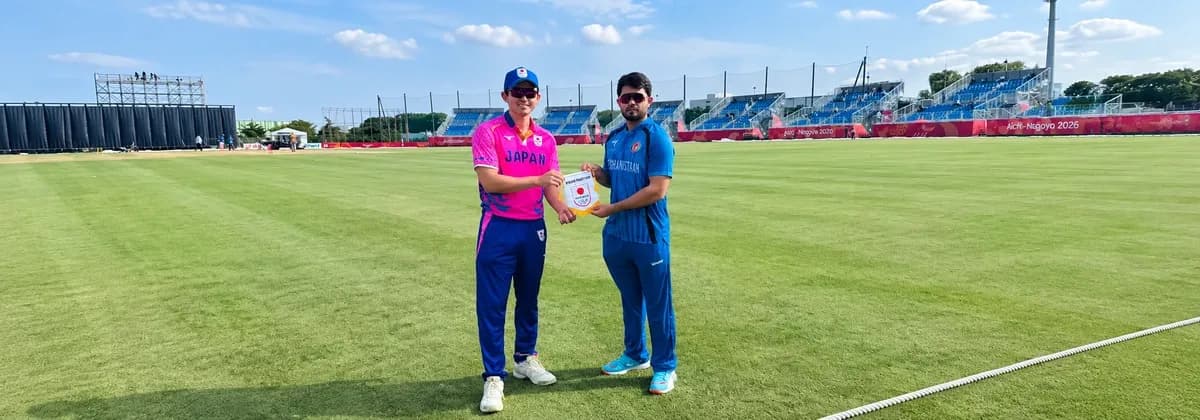
Just 48 hours after the dramatic wide-call reversal against India in Sano, officiating precision and the interpretation of tramlines returned to center stage on Thursday morning. Taking the field at the Aichi Prefectural Korogi Sports Park in Nisshin for the opening men's group fixture of the 2026 Asian Games, Japan found themselves in another tightly contested strategic battle against Full Member opposition Afghanistan. While Afghanistan asserted control to seal a 48-run victory, the spotlight remained firmly fixed on the match officials' handling of wide lines as batters repeatedly looked to alter their stance.
DailyCricInfo breaks down the match context, officiating dynamics, and verified tactical takeaways from Nisshin.
The Lingering Shadow of Sano: Stance Changes and Tramlines
The wide-ball regulation was thrust into global discussion on Tuesday when officials Chris Thurgate and Chris Brown correctly overturned a wide signal during the final over against India. The ruling rested on the ICC guideline that an attempted reverse sweep or switch hit nullifies the strict leg-side wide rule, bringing the 75-centimetre off-side tramline into effect on both sides of the wicket.
As Japan lined up against Afghanistan in their Asian Games opener, the umpiring panel, featuring ICC Elite Panel official Nitin Menon and Faisal Afridi maintained absolute vigilance over tramlines from ball one.
With Japan's bowlers utilizing variations into the hybrid surface, and later when batters attempted to manipulate the field against Afghan spin, the officials adhered strictly to the ICC standard. Whenever batters shifted stance or pre-meditated ramp sweeps across their stumps, the umpires allowed bowlers leeway on the leg side, ensuring clarity and consistency across the 40 overs.
Match Recap: Arab Gul's Four-Wicket Web Bundles Japan for 81
On the field, Afghanistan demonstrated clinical discipline after being inserted to bat by Japan captain Kendel Kadowaki-Fleming.
Despite a sluggish start against disciplined spells from Ibrahim Takahashi (2 for 19) and Reo Sakurano-Thomas (1 for 6), Afghanistan posted a competitive 129 for 6 in their 20 overs. Mohammad Akram top-scored with a measured 34 off 29 deliveries, supported by middle-order contributions from captain Darwish Rasooli (29 off 27) and Mohammad Ishaq (25 off 17).
Chasing 130 on a gripping, turning deck, Japan's reply struggled to build momentum.
Alexander Shirai-Patmore, at the center of Tuesday's wide debate, was contained early by Afghanistan's spinners before falling to Najibullah Zadran for 2 off 12 balls. Left-arm spinner Nangeyalia Kharote struck key blows by removing Kadowaki-Fleming (14) and Benjamin Ito-Davis (17) to finish with 3 for 19.
Leg-spinner Arab Gul delivered the decisive spell of the morning, dismantling Japan's middle and lower order with precision. Operating with sharp bounce, Gul bowled two maidens and claimed 4 for 8 in four overs, leaving Japan stranded on 81 in 19.3 overs as Afghanistan closed out a 48-run win.
The disciplined officiating throughout the contest reinforced the clarity established by the ICC Almanac: when batters deploy modern unorthodox strokes, match officials will hold firm to the playing conditions.
For live Asian Games scorecards, rule breakdowns, and real-time tournament analysis, keep following DailyCricInfo.
Written by
Team DailyCricinfo
Cricket correspondent at Daily Cric Info.